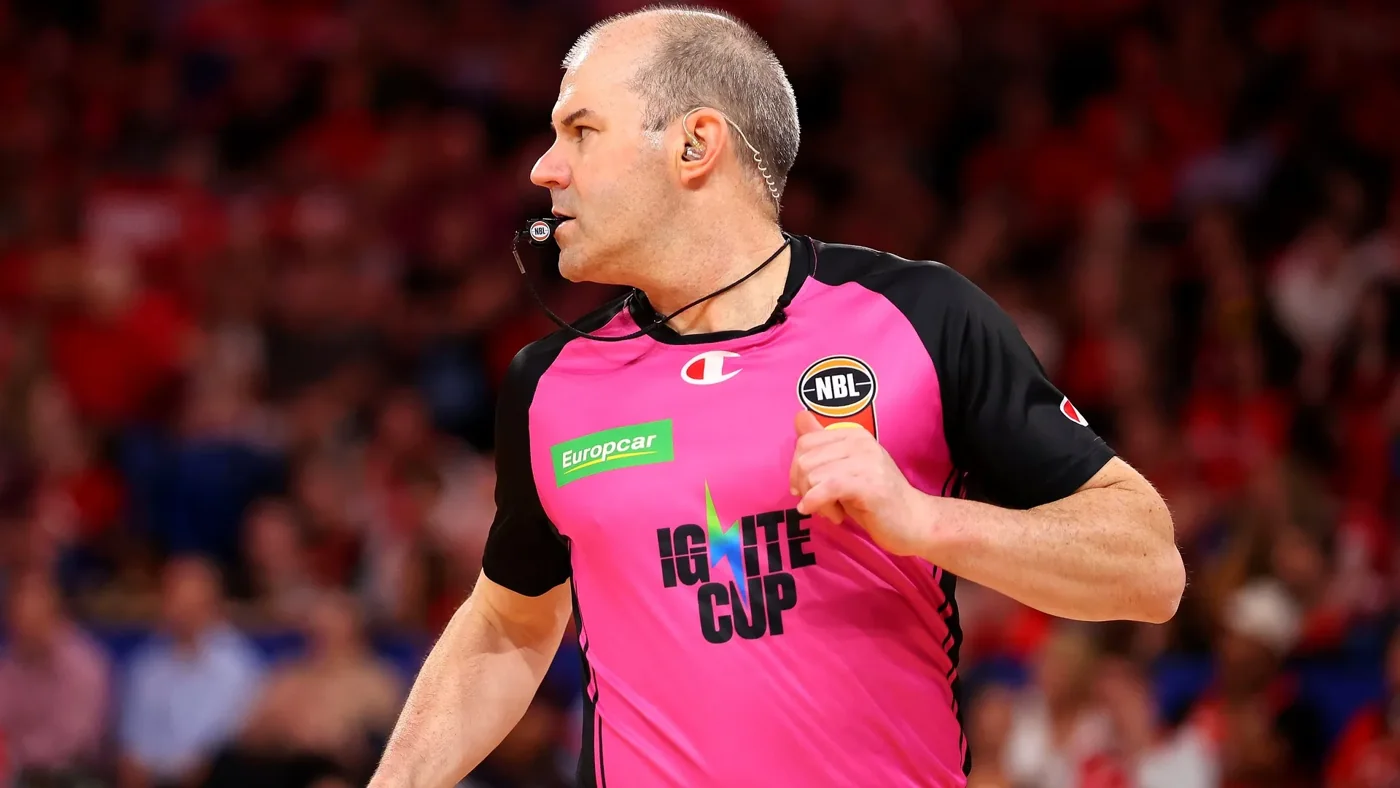
Start with the offence, not the ejection count
The useful question after a contentious NBL whistle is no longer simply whether the referee has called an unsportsmanlike foul. The 2026 framework separates disruptive contact from flagrant contact, and divides technical fouls into two categories. Those distinctions affect both the immediate punishment and the disciplinary record that can eventually remove a player. A foul can be expensive without contributing to that particular automatic disqualification calculation.
There is also a date trap. The NBL's current explanation says its implementation starts at the CODE Sports NBL Blitz. The FIBA 2026 rulebook carries a worldwide validity date of 1 October. Those are different statements about implementation, and neither justifies inventing an NBL midseason change on 1 October. For an NBL27 viewing guide, the important starting point is the competition's explanation of its own adoption.
Think of two decisions running alongside each other. First, what happened? A defender might make ordinary illegal contact while genuinely contesting the ball, grab a runner to prevent a transition opportunity, or make dangerous contact that goes beyond an acceptable basketball action. Separately, a player might direct unacceptable behaviour towards an official. The physical outcome of a collision, the crowd's volume and the identity of the player do not replace the criteria governing those decisions.
Second, what follows? The answer may involve free throws, possession, a personal-foul entry, a team-foul entry or a disciplinary mark. These are related consequences, not interchangeable labels. Reading a television graphic as though every mark has the same meaning makes the new system look contradictory when its purpose is to distinguish different types of offence.
For supporters, that distinction is worth learning before the next close finish. It explains why a coach can be furious about the cost of one incident while still keeping the offending player on court, and why another apparently separate act of dissent can become decisive later. The aim here is to connect the terminology to basketball decisions: the defender's approach, the action being stopped and the choices left to the coach. Keep the fixture calendar handy for watching the next game; the framework below is a way to read the whistle rather than guess from the reaction.
Disruptive fouls punish the tactical stop
A disruptive foul addresses an unfair interruption that does not reach flagrant severity. The key is not that play has stopped: ordinary fouls stop play too. The referee has to identify the action described by the rule. That matters because supporters often see a mild-looking grab and assume the small amount of force must make the call excessive. The relevant disadvantage may be the opportunity removed, rather than the violence of the collision.
The transition grab and the late-clock foul
Under Article 37 of the 2026 rules, unnecessary defensive contact without a legitimate direct attempt to play the ball can qualify when it stops an attacking team in transition. Imagine a guard beaten in the open court who takes hold of the ball-handler rather than trying to contest the dribble. That example is about the defender's action and the lost advantage; a spectacular fall is not required to make the question relevant.
A separate criterion covers unnecessary defensive contact, anywhere on court, without a legitimate direct play on the ball to stop the game clock or shot clock at the end of a quarter or overtime. A late-game tactical foul therefore still needs examination. Saying a team wanted the clock stopped does not settle the classification by itself: watch whether the defender actually attempts a legitimate basketball play or simply reaches for the opponent.
The breakaway criterion is another distinction worth recognising. It concerns illegal contact from behind or the side on an opponent progressing towards the basket with no opponent between that player and the basket. It can cover the player controlling the ball, trying to gain control, or receiving a pass already released. Looking only for the ball-handler can miss the relevant attacker. The transition and breakaway criteria apply until the attacker begins the act of shooting, so the sequence and timing matter.
Why free throws and possession still matter
The non-shooting disruptive-foul penalty is two free throws followed by the fouled team's frontcourt throw-in from the designated line opposite the scorer's table. Article 37 also specifies the relevant made-basket and missed-shot alternatives for an offence assessed in the act of shooting. That possession component is the tactical point: the defence does not simply exchange a promising break for a routine restart and reset the contest on comfortable terms.
For a coach, the likely cost has several parts. There is the foul charged to the player, the addition to the team's foul count, the free-throw opportunity and the next attacking possession. None is a guarantee of points. A team can miss its shots or waste the restart. But treating the absence of an automatic ejection mark as permission to collect disruptive fouls overlooks the immediate damage. The rule makes a distinction in disciplinary severity while still protecting the advantage the attacking team had earned.
Flagrant contact crosses a different line
Flagrant is a different judgement from a tactical interruption. Article 38 describes contact that exceeds the limits of a personal or disruptive foul through its nature or severity. Its criteria include an action that is not a legitimate basketball play, dangerous or reckless conduct that causes or could cause injury, and excessive hard contact even during an effort to play the ball or an opponent.
The final part explains why touching the ball does not automatically settle an argument. A defender can get a hand near the ball and still use excessive force. Equally, a hard landing does not by itself establish the classification of the preceding contact. The referee has to evaluate the action. Supporters should look at how the player arrives, the available basketball play, and the force or danger involved, rather than treat the injured player's reaction as the rulebook.
Imagine two hypothetical situations. In one, a beaten defender briefly holds a runner before the shooting motion begins to stop a break. The disruptive criteria may be the relevant starting point. In the other, a player makes a reckless contact that endangers an airborne opponent. The safety question puts that action on a different footing. These are illustrations of the distinction, not a promise that every clip fitting a loose description must receive the same call: angles, timing and the precise contact remain important.
That is also why an argument about intention can become a dead end. A player can insist there was no desire to injure anyone, but the rule expressly includes dangerous actions that may cause injury. The job is to judge the conduct, not obtain a confession. A fair assessment should allow that a player was attempting to compete while still recognising an action outside acceptable limits.
The sanction has two layers. There is the immediate free-throw and possession penalty specified in Article 38, including its shooting alternatives. There is also a flagrant mark that contributes to the automatic game-disqualification combinations. A coach therefore has to think beyond the current scoreboard. The defender who has already received such a mark carries a different disciplinary exposure for the rest of the contest.
Do not import the NBA's numbered flagrant vocabulary into that calculation. Use the NBL/FIBA classification actually announced and the current wording of the rule. Nor does the accumulation system mean that an official must wait for two incidents before removing someone for a separately disqualifying action. Article 39 remains a separate provision. The distinction is proportionality across different offences, not an allowance for one dangerous act before safety rules begin to matter.
Two technical categories change the disciplinary equation
Technical fouls now require a category as well as a name. The change is easy to misunderstand if the television commentary says only that someone has been given a technical. For a player, both categories carry a penalty, but they do different work in the automatic disqualification calculation. The nature of the behaviour remains central.
Category 1: conduct that counts towards disqualification
Category 1 includes disrespectful communication with officials, taunting or provoking opponents, offensive language or gestures and simulating a foul. The full Article 36 list goes further than those familiar examples. The common thread is that these are the more serious behavioural offences for the purposes of game-disqualification accumulation.
That does not turn every disappointed expression into an automatic technical. Officials still have to judge the behaviour and its context under the conduct provisions. The rules allow preventative warnings and discretion over minor, obviously unintended infractions that have no direct effect, subject to repetition. A useful fan discussion asks what was actually said or done, what the official could observe and how comparable behaviour was treated. A distant camera shot cannot reliably supply words that were never audible.
Foul simulation deserves attention because it is conduct, not simply a missed shot or an unsuccessful appeal. A player who genuinely loses balance is not proved to be faking just because no foul is called. Conversely, an exaggerated attempt to manufacture the impression of illegal contact can raise a separate technical-foul question. Classification should follow evidence of the action, rather than whether supporters dislike the player.
Category 2: a penalty without the same automatic trigger
Category 2 covers a different group of player offences, including specified delays and administrative conduct. Deliberately interfering with a prompt restart is an example. Ring-hanging also has specific wording and exceptions, including momentary holding following a dunk and actions to prevent injury. That detail matters: the visual image of hands on the ring is not sufficient on its own to settle every case.
A player's Category 2 technical does not contribute to the same automatic disqualification count as Category 1. It still counts as a player foul and a team foul, however, and the opponents receive the technical-foul free throw. The normal restart preserves the ball entitlement described in Article 36; a technical is not automatically the same free-throws-plus-possession package as a disruptive or flagrant contact foul.
Keep the player and bench cases separate as well. Article 36 treats technical offences by people permitted on the bench differently, charging the relevant Category 1 technical to the head coach without adding it as a team foul. The coach has separate accumulation provisions. A supporter cannot safely apply the player's two-category shortcut to every whistle directed towards the bench. The sensible first question remains: who was charged, with what category, and under which provision?
Which combinations actually end a player's game?
The automatic disciplinary combinations for a player are straightforward once the category is known. Two Category 1 technicals trigger game disqualification. So do two flagrant fouls, or one of each. Disruptive fouls and Category 2 technicals are excluded from that particular combination. The qualification is important: this is not the only rule that can end a player's participation.
| Player's recorded combination | Automatic disciplinary trigger? |
|---|---|
| Two Category 1 technicals | Yes |
| Two flagrant fouls | Yes |
| One Category 1 technical and one flagrant | Yes |
| A disruptive foul and a Category 2 technical | Not through this combination |
The mixed flagrant-and-technical case
Consider a hypothetical player charged with a flagrant in the first half who later receives a Category 1 technical for misconduct. The second incident need not resemble the first. They combine because both belong in the specified disciplinary count. A coach watching only for a second heavy contact could miss the significance of a subsequent argument with an official.
Now change the later incident to a Category 2 player technical. The same mixed automatic trigger does not arise, but the new technical still adds to the player's foul total. Article 41 separately requires a player who has committed five fouls to leave the game. Describing the player as completely safe because the technical was Category 2 would therefore be wrong. One count concerns the type of disciplinary offence; another concerns the total number of fouls.
There is also the separate direct-disqualification provision. It cannot be reduced to a calculation of previous marks. Nor does an automatic game disqualification automatically create an additional free-throw penalty on top of the incident that triggered it: the rule specifies that the triggering foul is the one penalised. This is why the official explanation and scoresheet entries are more useful than a generic graphic reading only technical or foul. The coach needs the classification to know both the current sanction and the remaining exposure.
What to watch when the next whistle blows
The same update also changes how the act of shooting is described. That matters to the contact discussion because the moment a transition action becomes a shooting action can affect which criterion or penalty applies. On jump shots, watch the shoulders and ball beginning their upward movement towards the basket. On a drive, watch the gather and the continuation of the shooting motion. A later shot attempt is not automatically proof that every earlier contact occurred during a shot.
Article 15 adds important qualifications about direction, position and what happens afterwards. Passing the ball after contact can remove the relevant act-of-shooting status under its provisions. For jump shots and other moving shots, moving the ball upwards away from the basket or doing so while not facing the basket is also addressed. That is a more precise test than assuming a player can turn any contact into shooting free throws simply by lifting the ball.
Replay is another area in which precision helps. The NBL identifies additions involving the timing of a throw-in release when a defensive foul occurs late in the fourth quarter or overtime, and goaltending or basket interference after a foul. Those are defined review situations. The existence of an expanded replay system does not mean the officials can stop the game and reconsider any contact that looked wrong on television. The applicable review category and procedure still matter.
For the next contentious sequence, follow the decisions in order. Identify the action and who was charged. Find out whether the call concerns ordinary contact, a disruptive interruption, flagrant contact or a technical category. Then separate the immediate penalty from the player's disciplinary record and overall foul total. Finally, if a monitor is involved, ask which review provision is being used before arguing about what the pictures prove.
That approach leaves plenty of room to disagree with an interpretation. It simply makes the disagreement more useful. A claim that a challenge was unavailable is different from a claim that the initial contact was legal; a complaint about excessive force is different from a complaint that a transition grab cost too little. The best discussion of NBL27 officiating starts with the actual decision being made, then tests it against the action and the applicable rule.
Join the conversation
Share a question or a thought about NBL basketball. Comments are reviewed before they appear. Keep it friendly and on topic.
No comments yet. Start the conversation.
Sign in with Google to leave a comment. Your email address is not displayed.